ANALYSIS #03
How I'd grow Payhawk
A fintech where customers spend 73.5% more every year. The website doesn't explain why.
9 min read · April 2026
Bulgaria's first unicorn and its bet against legacy software
Payhawk is a spend management platform for companies with 60 to 500+ employees operating across multiple countries. Corporate cards, expense management, supplier payments, travel, and procurement in a single system.
They've raised $239M, have an ARR (Annual Recurring Revenue) of €39.5M growing at 78% year-over-year, and process $3.2B in payment volume. Offices in London, Sofia, Barcelona, Berlin, Paris, and New York. And one metric that stands out: an NRR (Net Revenue Retention, how much more existing customers spend year after year) of 173.5%. Their customers spend 73.5% more each year without Payhawk having to acquire a single new customer.
How? With an expansion loop that already works: a finance team signs up in one country, sees value, and connects more entities through Link & Control (the feature that lets you manage multiple companies from a single account). Each new entity generates more revenue at zero acquisition cost.
Their target audience is finance teams that need control over multiple entities and currencies, looking for a modern alternative to SAP Concur (the expense management software that has dominated the enterprise market for decades).
Three things Payhawk does well
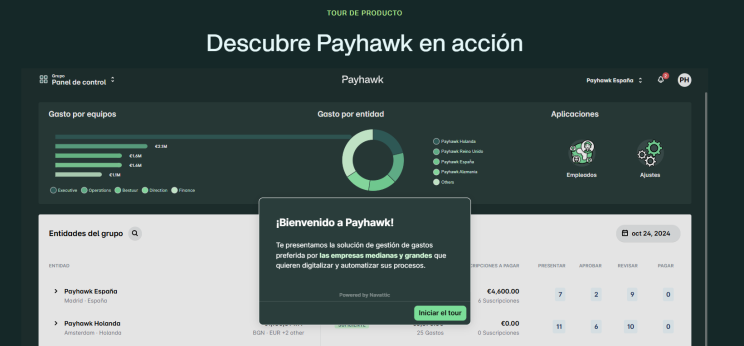
The Product Tour. It's the best thing on the entire website. It walks the visitor step by step through the main features: cards, expenses, purchase automation, supplier payments. Each section shows the role's pain point, how to set it up, and use cases. No email gates, no forms in the middle. It sells itself.
Regulatory credentials. Payhawk holds an EMI (Electronic Money Institution) license in the EU and UK, is a principal member of Visa, and has ICAEW accreditation. This matters because it means Payhawk can issue electronic money, operate cards, and manage funds directly, without relying on an intermediary bank. For a finance team managing spend across multiple countries, it's the difference between trust and no trust. Ramp, their strongest US competitor, can't replicate this without years of European regulatory process.
AI Agents. They launched four agents in fall 2025: Financial Controller, Procurement, Travel, and Payments. The Travel Agent is already used by 20% of their customers. Invoice Fetch, launched in March 2026, directly accesses supplier portals like AWS, Meta Ads, or Google Cloud to download invoices automatically. Neither Pleo (Europe's most popular expense platform for small companies) nor Spendesk (their direct competitor in the mid-market segment) have anything equivalent today. That gives Payhawk a 12 to 18 month window to consolidate this position before the rest of the market catches up.
Five hidden opportunities on their own website
The hero talks about Payhawk, not its customer

"Smart money just got smarter." It doesn't say what the product does, who it's for, or what problem it solves. It's a pattern that repeats: Amenitiz with "Software for Hotels" and Lemlist with "AI sales engagement platform for precision outbound". Open Pleo side by side, and their headline connects spending to business outcomes. Open Ramp, and their message is polarizing but clear.

Payhawk uses an inverted pyramid: lots of information first, the essentials later. It should be the other way around. The problem the finance team faces first, features second. And social proof (G2 4.5, Capterra 4.6, EMI license) should be in the hero, not three scrolls down.
Nobody knows how much it costs
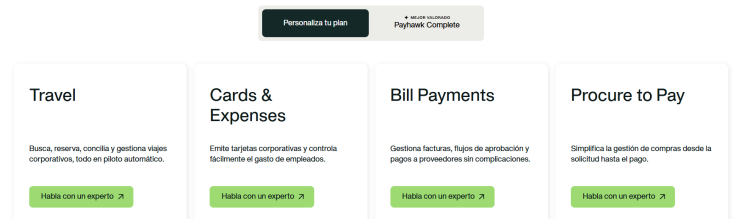
Four out of five plans show no price. Everything leads to "Talk to an expert." The problem: 80% of B2B buyers research pricing before talking to sales. Without a range, the visitor in active evaluation assumes it's expensive or there's a catch. Pleo shows full pricing starting at €4 per month. Ramp has a permanent free plan.
Publishing "from €X per entity per month" on the pricing page doesn't compromise enterprise negotiations. It removes friction for those already convinced who need to build an internal business case before scheduling a call.
The Growth Program says one thing, reviews say another
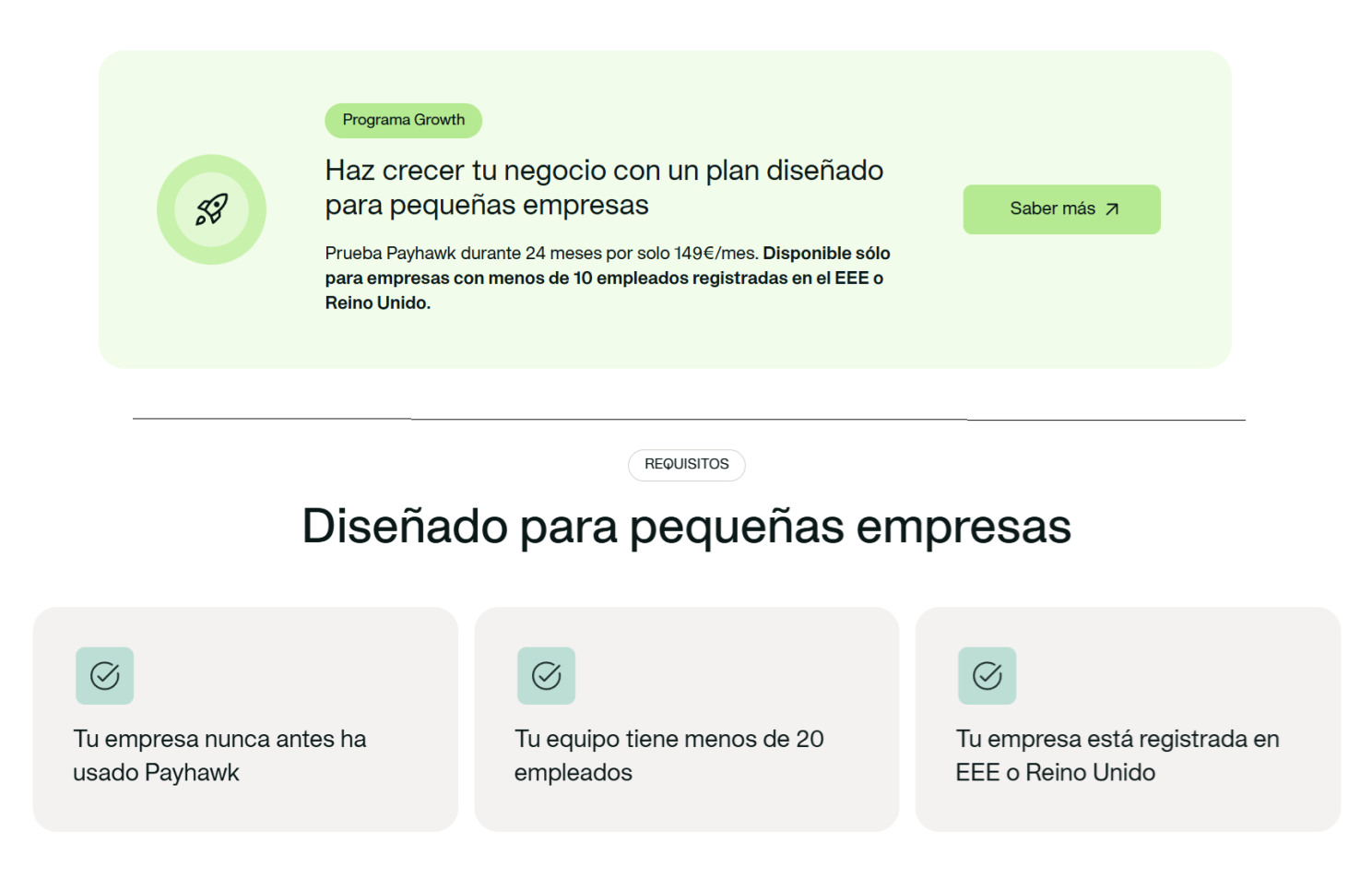
The entry plan costs £149 per month for companies with fewer than 20 employees, with limits of 15 invoices and 15 reimbursements per month. Meanwhile, Trustpilot reviews report that Payhawk closed their account with 10 days notice when they pivoted to larger customers. In another review, a customer reports a 22% price increase mid-contract, and Payhawk confirms it in their own public response.
If they no longer serve that segment, clarity would be more valuable than ambiguity. Keeping an entry plan that creates expectations it won't meet produces early churn and reviews that poison the funnel.
The contact form doesn't qualify
Eight fields, none asking what the visitor's problem is. The sales team receives leads with no context on urgency, budget, or pain. Adding one question ("What's your main challenge with spend management today?") personalizes the first call and filters better than company size.
Integrations promise more than they deliver
The website lists integrations with SAP, NetSuite, Xero, Dynamics, and 30+ HR tools. Depth varies. In the Q&A of their Spring 2026 Product Showcase, when asked about native SAP S/4HANA integration (the world's most widely used enterprise ERP), the answer was: "coming soon," with no date. Reviews report constant errors exporting to Xero and months stuck in NetSuite sandbox without going live. The 30+ HR integrations are one-way employee syncs, not deep integrations.
What they have is a broad catalog. What's missing is documented depth for each system.
A loop hidden in $3.2B of spending data
Payhawk processes $3.2B in payment volume. Thousands of European companies running spend through the platform every day. That's not just transactions. It's a database of real spending patterns by industry, company size, and country.
Today that data only serves operations. But there's a second use that no European competitor is leveraging: anonymous corporate spending benchmarks.
A finance controller managing the budget for a 150-person company needs to answer questions like: are we spending too much on cloud? Is our travel cost normal for our sector? How does our software spend compare to similar companies?
Today they search Google for those answers and don't find them. Consulting firms charge thousands for that data. Payhawk has it for free as a byproduct of its operations.
Payhawk publishes anonymous spending benchmarks by sector and size. Finance controllers find them while searching for data to justify budgets internally. They download the report. They discover that Payhawk doesn't just have the data but the platform that generates it. They sign up. More customers produce more data. Better benchmarks. Harder to copy.
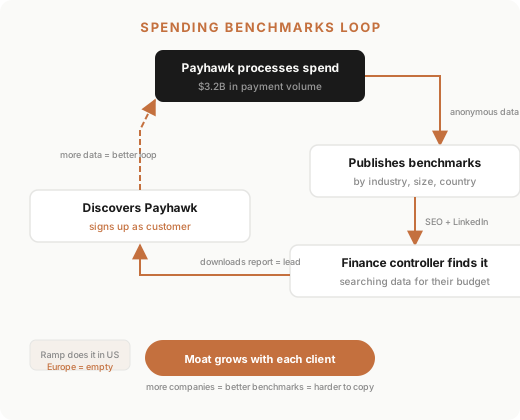
Ramp already does this in the United States with their spending reports, and it's one of their strongest acquisition channels. In Europe, nobody occupies that space. And Payhawk has the scale to do it.
What's interesting is that this loop connects directly to the problem in this article: all of Payhawk's messaging speaks to the CFO, but the person searching for benchmarks to build the business case is the finance controller. Publishing this data is speaking to that person, with what they need, at the moment they need it.
Three levers before touching the product
What I've learned working at Mentorhood is that many times it's not about creating more, but improving what's already there. When a product has traction (and €39.5M in ARR is traction), what slows growth is almost never the product. It's how you communicate it.
Lever 1: Rebuild the hero.
Flip the pyramid. Open with the problem facing the finance team managing spend across five countries with Excel and their bank's portal. Move social proof to the first scroll: G2, Capterra, EMI license. And on the pricing page, show a range that lets the visitor decide if it's worth scheduling a call.
Lever 2: Put the Product Tour front and center.
It's the best thing they have, and it's in the background. The Product Tour should be the primary CTA alongside "Talk to an expert," not hidden as a secondary option. And in the contact form, add a question about the visitor's pain point. That personalizes the first call and improves close rates.
Lever 3: Talk to the finance controller, not just the CFO.
All of Payhawk's content, messaging, and targeting is aimed at the CFO (Chief Financial Officer). But in companies with 60 to 200 employees, the person who discovers the tool and runs the initial evaluation is usually the finance controller or head of finance. If you only talk to the CFO, you depend on someone else bringing the product to their attention. If you talk to the finance controller, you give them the tools to make the case internally.
Before building the next feature: is your website selling the ones you already have?
What's happening to Payhawk is happening to many companies right now. With the speed AI enables, building is easier than ever. Launching features, adding modules. And the natural impulse is to keep building.
But building fast doesn't mean what you already have is being communicated well. Payhawk has a Product Tour that's one of the best product experiences I've seen in European B2B SaaS. Their regulatory credentials would take years for any American competitor to replicate. And their AI Agents have no equivalent in Europe today.
Sometimes the opportunity isn't in the next feature. It's in looking at what you've already built and asking yourself: is my website telling the right person, at the right time, with the information they need to take the next step?
It seems obvious until someone who's never seen your website, and who fits your ideal customer profile perfectly, tells you they don't understand what you sell.